I Audited Escourtly's AI Search Visibility and Found 0% — Here's What I Did About It
A few weeks into rebuilding Escourtly, I started wondering whether anyone using ChatGPT or Perplexity to find tools like mine would ever come across it. Not Google; AI search. The kind of search where someone types "what's a good tool for sharing a product demo without a call" into Claude or Perplexity and gets a list of recommendations back.
So I ran an audit. What I found was not encouraging, and I want to document exactly what I found, why it happened, and what I did about it, because this is a problem almost every early-stage SaaS founder has and almost nobody is talking about honestly.
What GEO Actually Is and Why It Matters Now
GEO stands for Generative Engine Optimisation. It is the practice of making your brand, product, or content visible inside AI-generated responses. The answers that ChatGPT, Claude, Perplexity, and Google's AI Overviews produce when someone asks a question.
Traditional SEO is about ranking in a list of blue links. GEO is about being cited, mentioned, or recommended inside an AI-generated answer that may not have blue links at all. When someone asks Perplexity "what are the best tools for creating interactive product demos," they get a paragraph with specific tool recommendations. The tools that appear in that paragraph are winning GEO. The tools that do not appear do not exist to that user.
The shift matters because the way people find software tools is changing. Founders, marketers, and developers increasingly start their tool research with an AI conversation rather than a Google search. If your product is not showing up in those conversations, you are invisible to a growing segment of exactly the buyers you want to reach.
I built Escourtly to help founders share interactive demos of their products without requiring a demo call. My potential customers; solo founders, indie hackers, early-stage SaaS teams are precisely the people most likely to use AI search to find tools. So the question of whether Escourtly shows up in those answers was not an academic one for me. It was a direct revenue question.
How I Ran the Audit
I used Lettertrace, a tool that automates GEO audits by running a set of questions through multiple AI models and tracking which brands get cited, how often, and with what sentiment. You define the questions your potential customers might ask, and Lettertrace shows you exactly how each AI model responds to each one and whether your brand appears anywhere in those responses.
I defined 22 questions that I believed represented the real searches my target customers were running. These covered the core use cases Escourtly addresses and the problems it solves. Some examples:
- "What's a good alternative to Loom for creating product demos that let people explore?"
- "What tools let me capture and share product walkthroughs that prospects can click through?"
- "What's the best way to show prospects my product before they schedule a demo call?"
- "What are the best interactive demo tools for solo founders?"
- "How do I create a product demo I can share as a link?"
- "What's a lightweight tool for recording and sharing interactive product tours?"
- "What are some examples of interactive product demos done well?"
I then ran these 22 questions through the audit and waited for the results.
What I Found
0% Escourtly brand visibility across all 22 questions
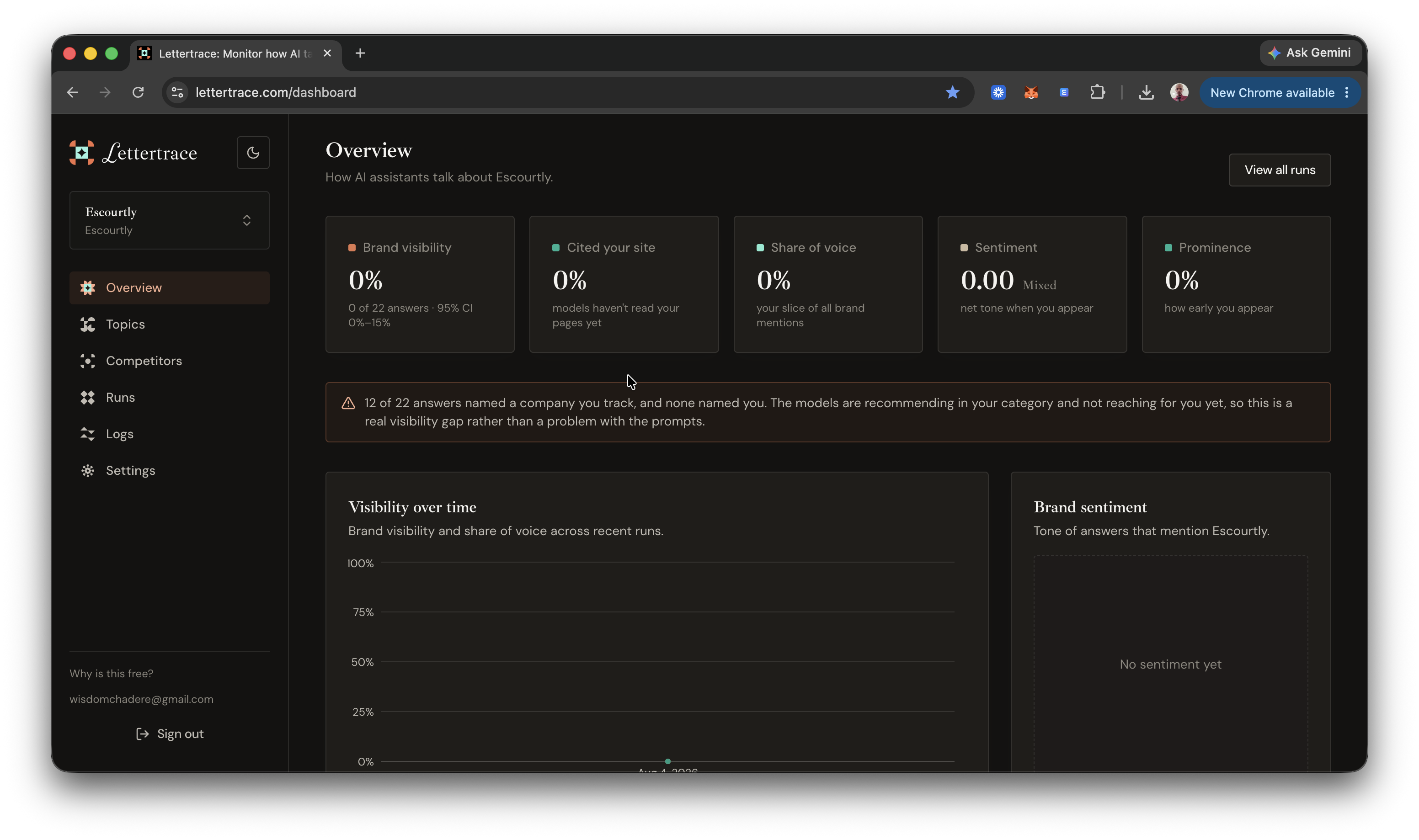
The headline number was 0%. Escourtly was not cited in a single response to any of the 22 questions I had defined. Not once, across any AI model, for any query.
That number alone was useful, but the more useful part was seeing exactly who was being cited instead.
Lettertrace competitor visibility breakdown
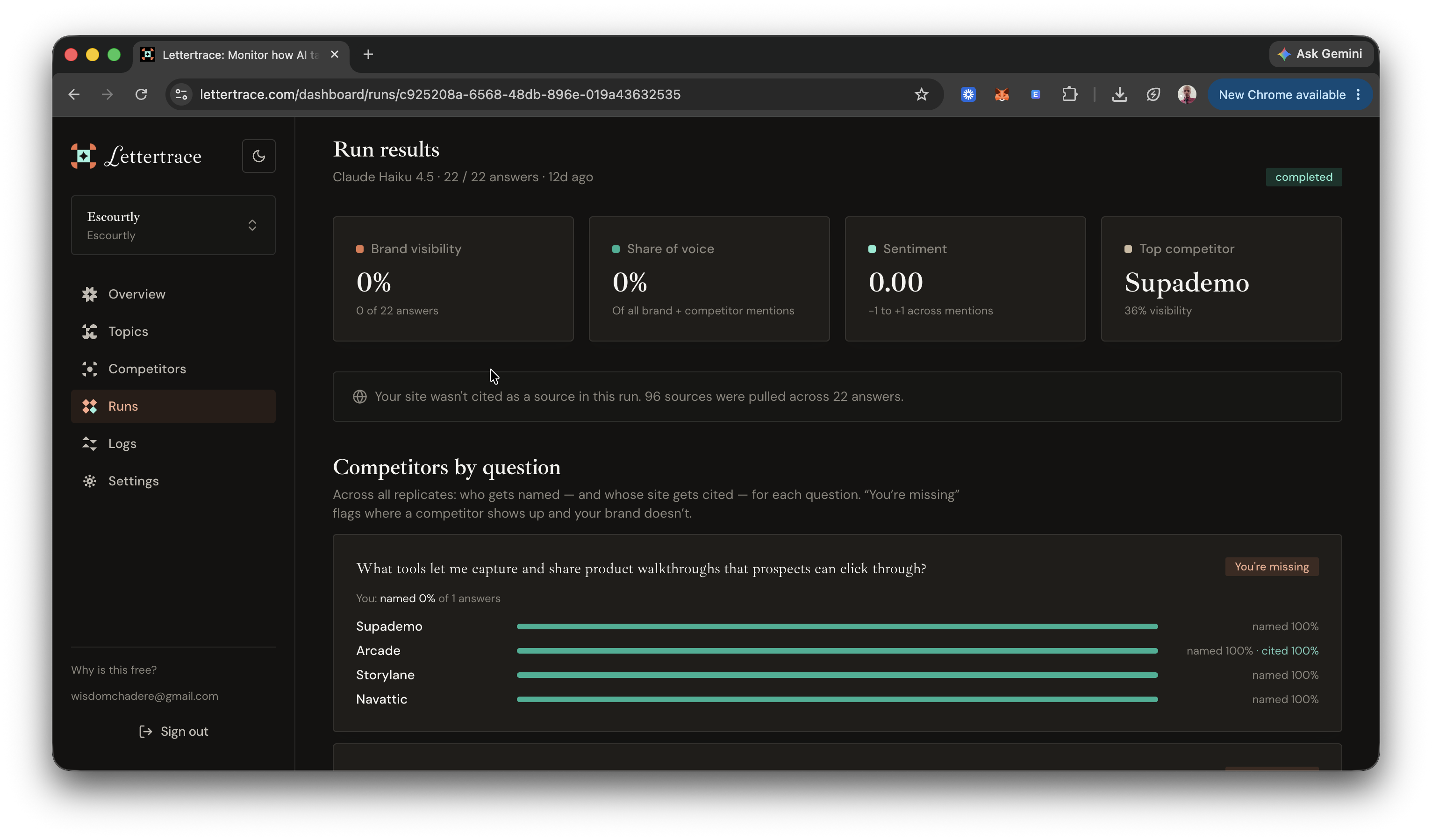
Supademo appeared in responses to 36% of the questions I tested. Arcade appeared in roughly 28%. Storylane appeared in 22%. Navattic appeared in 18%. These four tools were collectively dominating the AI search results for every category of query I cared about.
The pattern was consistent across all 22 questions. It did not matter whether the question was about cold outreach, landing page demos, solo founders, or enterprise teams — the same four or five tools kept appearing and Escourtly was not among them.
Lettertrace question-by-question breakdown showing which tools appear for each query
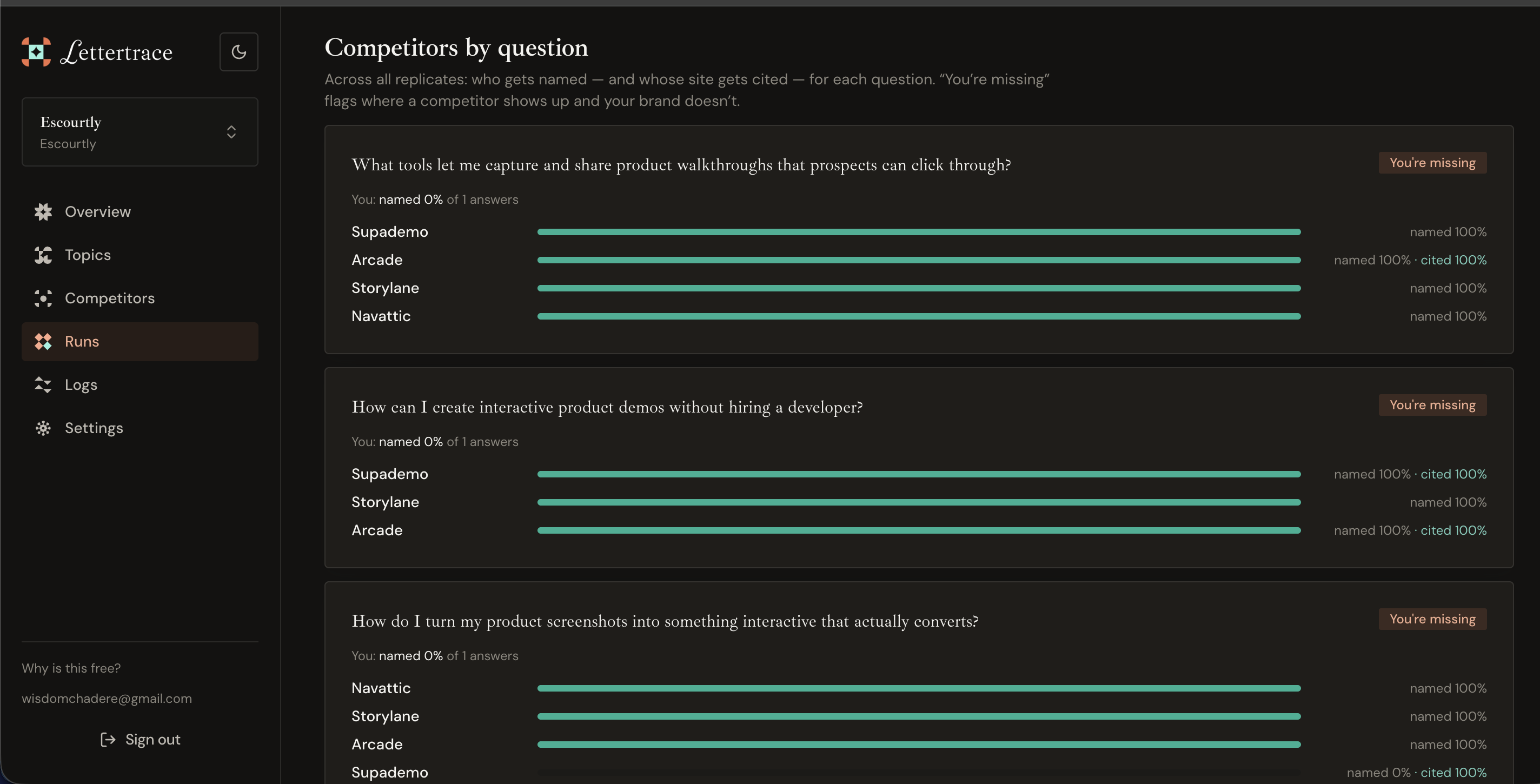
When I looked at the individual question results, I noticed something important about why this was happening. The tools being cited all had one thing in common: they had published substantial content that directly answered these exact questions. Supademo had a blog post titled "Best Loom Alternatives for Product Demos." Arcade had a page about interactive demos for cold outreach. Storylane had a roundup of the best interactive demo examples.
AI models do not recommend products from memory. They recommend products that have been mentioned and validated in content they have indexed. If you have not published content that explicitly addresses the questions your customers are asking, you are not in the running to be cited, regardless of how good your product is.
Escourtly had published two blog posts at the time of this audit. Both were personal founder stories — the relaunch post about v1 failing, and a post about why I stopped sending Loom videos. Both were good content for building a human connection with readers. Neither was the kind of explicit, question-answering content that AI models pull from when generating recommendations.
Why This Happened
The root cause was not complicated once I understood it. I had been writing content for humans who were already reading my blog, not for AI models that were scanning the web to answer specific questions.
The relaunch post and the Loom alternatives post are personal, first-person narratives. They build trust and tell a story. But when an AI model is answering the question "what are the best interactive demo tools for solo founders," it is not looking for a founder's personal story. It is looking for content that explicitly names tools, compares them, explains what they do, and answers the specific question. My content did not do that.
There was also a structural problem. The blog posts I had published were indexed, but they were not supported by any backlinks or citations from other sources. AI models weight content more heavily when it has been referenced elsewhere — when other publications, tools directories, and community sites link to it as a source. My domain was new, my domain rating was 4, and I had almost no external references pointing to my content.
The combination of not writing the right kind of content and not having any external validation meant that even if an AI model had found my blog, it would have had little reason to trust it as an authoritative source on the topic.
What I Did About It
Once I understood the problem clearly, the fixes were more straightforward than I expected. They were not quick — content takes time to get indexed and cited but they were not complicated. Here is exactly what I did.
Fix 1 — Wrote Explicit Question-Answering Content
The first thing I did was write content that directly answered the specific questions where I had 0% visibility. Not personal stories, not product announcements, but focused articles that answered one question clearly and completely.
I wrote "Best Interactive Demo Tools for Solo Founders in 2026". A roundup article that explicitly covers the tools in this category, their pricing, their strengths and limitations, and who each one is best for. This is the type of content AI models pull from when answering "what are the best interactive demo tools."
I wrote "Best Loom Alternatives for Product Demos in 2026", targeting the specific query where Supademo and Arcade had the most visibility in my audit. This article directly answers the question, names the tools, and explains the differences between them honestly.
I wrote "How to Show Your Product to Prospects Without a Demo Call", targeting the cold outreach use case where my tool has the clearest advantage and where several of my 22 audit questions were clustered.
Each of these articles uses the exact language from the questions I audited. If the question is "What tools let me capture and share product walkthroughs that prospects can click through," the article answering it needs to contain that language naturally in its content. AI models match queries to content partly through semantic relevance, and using the actual words from real queries matters.
Fix 2 — Built Focused Landing Pages for High-Volume Queries
Beyond blog posts, I built three focused landing pages that each answer one specific question and nothing else. These are not full blog articles. They are 600-900 word pages that exist at short, memorable URLs and answer one query with precision.
These pages are tightly focused because that is what AI models respond to. A page that tries to cover everything is less likely to be cited for any specific question than a page that covers one thing completely. Each page includes the exact question language in the H1, answers it directly in the first paragraph, and links internally to the relevant blog posts for readers who want more depth.
Fix 3 — Submitted Everything to Google Search Console Immediately
Every piece of content I published went straight into Google Search Console for manual indexing. New content can sit unindexed for weeks if you wait for Google to find it naturally. Manual submission through Search Console dramatically shortens that window.
Fix 4 — Started Building Backlinks From Relevant Sources
AI model citations weight content from sources that have external validation, other sites linking to them as references. With a domain rating of 4, I had almost none of that.
I submitted Escourtly to relevant directories that provide genuine dofollow links: BetaList, G2 reviews, scrollLunch, and SaaSHub. I wrote an article on Dev.to about building Escourtly's Chrome extension and linked back to the main site.
None of these are high-authority links individually. Collectively they begin building the signal that tells AI models Escourtly exists as a real product that other places on the internet have referenced.
Fix 5 — Aligned Content Language With Actual AI Query Patterns
The final fix was the most subtle one. I went back through my existing content and checked whether the language I was using matched the language people actually use when asking AI models about this problem space.
People do not ask "What are the best interactive demo platforms for B2B GTM teams?" They ask "What's a good way to show my product without a demo call?" or "How do I share my SaaS product with someone who hasn't signed up yet?" The gap between how a founder writes about their product and how a potential customer asks about their problem is often significant, and that gap directly affects AI search visibility.
I updated headings, subheadings, and key paragraphs in my existing content to incorporate the natural language patterns from my Lettertrace audit. This is not keyword stuffing, it is making sure the content actually answers the questions people are asking in the language they use to ask them.
What I Have Not Done Yet and Why It Matters
I want to be honest about the limitations of what I have done so far, because this is an audit of a process in progress, not a success story.
The content I wrote and the pages I built need time to be indexed, crawled by AI training data pipelines, and begin influencing citation patterns. These things do not happen overnight. GEO is not like paid advertising where you can turn on a spend and see immediate results. It is more like traditional SEO, you do the work now and the results show up weeks or months later.
I have not yet re-run the Lettertrace audit because I want to give the content time to be properly indexed before measuring again. Running it too early would give me a misleading picture. I plan to run it again in four to six weeks and document what changed.
I also have not yet done any guest posting or third-party publication work, which is probably the highest-leverage thing remaining on my list. Getting an article published on an established publication in this space — even a mid-size one would provide a much stronger backlink signal than the directory submissions I have done so far. This is on the list.
What I Would Do Differently From the Start
If I were starting Escourtly's content strategy from day one with what I know now, I would reverse the order of what I published.
I published personal stories first and question-answering content second. The personal stories built human connection but did not help AI search visibility. The question-answering content directly addresses visibility but lacks the personal voice that makes people care.
The right approach is to do both simultaneously from the beginning, treating them as different content formats serving different purposes. Personal stories go on the blog as long-form posts. Question-answering content goes on focused landing pages and in roundup articles. Both get published from week one, not sequentially.
I would also submit to directories and community sites before publishing my first blog post rather than after. The backlink foundation matters more than I initially understood, and it takes time to build even at a small scale.
Why This Matters Beyond Escourtly

The pattern I described above is not specific to interactive demo tools. It applies to almost every early-stage SaaS product in a crowded category. Your competitors have content. The AI models have indexed that content. When potential customers ask AI search tools for recommendations, your competitors appear and you do not.
The solution is not complicated. Write the content that answers the specific questions your customers are asking, in the language they actually use to ask them. Get that content indexed and supported by external references. Do this consistently before you have traction, not after.
GEO is where SEO was in 2005. The companies that understood it early built advantages that compounded for years. The window to build that kind of early advantage in AI search is open right now, and it will not stay open indefinitely.
I am figuring this out on my own product in real time. Everything in this post reflects what I actually did, what I found, and what I am still working on. If you are building something and wondering whether anyone using AI search will ever find you, the answer to that question is almost certainly no right now — and the fix is more straightforward than it looks.